
“Feral cats are more likely to kill squirrels for food than domestic cats. This is because they need to catch prey for sustenance. Unlike domestic cats that have human owners to provide their food for them, feral cats rely on their hunting and scavenging skills to stay alive.
https://youtu.be/oOSYB38y2xA?list=RDoOSYB38y2xA
Stray Cat Blues
However, a study in Wildlife Research found that while barbary ground squirrels are preyed upon by feral cats, it’s less often than other mammals, like rabbits and mice. Squirrels are fast animals and can hide away up trees. Hungry feral cats are more likely to hunt slower-moving mammals that are easier to catch and kill.”
A few cats that can kill squirrels… coyote, bobcat, siamese, bengals, sphynx and scottish fold.
A few more: https://www.seniorcatwellness.com/do-cats-kill-squirrel/
Best Cats for Catching Squirrels
Some breeds are better for hunting rodents than others. Ultimately, a cat’s personality will have a significant impact on whether a cat likes to hunt or not. These are some of the besting hunting breeds:
American Shorthair 
Known as one of the earliest cat breeds to be kept in American homes, the American Shorthair started life on the Mayflower catching mice and has sharpened its hunting instincts since then to become one of today’s greatest feline hunters.
Siberian 
Weighing over 20lbs, Siberian cats are very agile, despite their size. They’re also powerful and strong. Because they come from the forests, they have maintained the hunting instincts of their wild ancestors. If they’re allowed to go outside, they will see birds, rodents, and other mammals as their natural prey.

Maine Coons are highly effective predators. Like leopards and tigers, they immobilize their prey by pouncing and piercing the neck with their long canine teeth. They love hunting and the thrill of the chase, they rarely eat their prey.

Chartreux cats are highly prized by farmers for their exceptional hunting skills. The breed was originally used to keep rodents out of the barn and house. Today, their hunting technique is silent, deadly, and effective.
Manx 
Manx cats are known as ‘tailless hunters’. They’re prized as excellent hunters and were often used on farms and ships to help with pest control.
Turkish Angora 
Turkish Angoras are self-sufficient street cats in their native Turkey. They stay fit by exercising their hunting instinct through the house with their toys. Outside, they are master hunters, having needed to find food to stay alive.
Japanese Bobtail 
The Japanese bobtail was first set free on the streets of Japan to hunt for rodents which threatened the silkworm population. They’re slender cats, which makes them agile.
1. Coyotes (these are NOT cats)  The coyote is a species of canine native to North America. It is smaller than its close relative, the wolf, and slightly smaller than the closely related eastern wolf and red wolf. It fills much of the same ecological niche as the golden jackal does in Eurasia. Coyotes are not cats but do kill squirrels.
| Domain: | Eukaryota |
| Kingdom: | Animalia |
| Phylum: | Chordata |
| Class: | Mammalia |
| Order: | Carnivora |
| Family: | Canidae |
| Genus: | Canis |
| Species: |
C. latrans
|
| Binomial name | |
|---|---|
| Canis latrans | |
https://en.wikipedia.org/wiki/Coyote
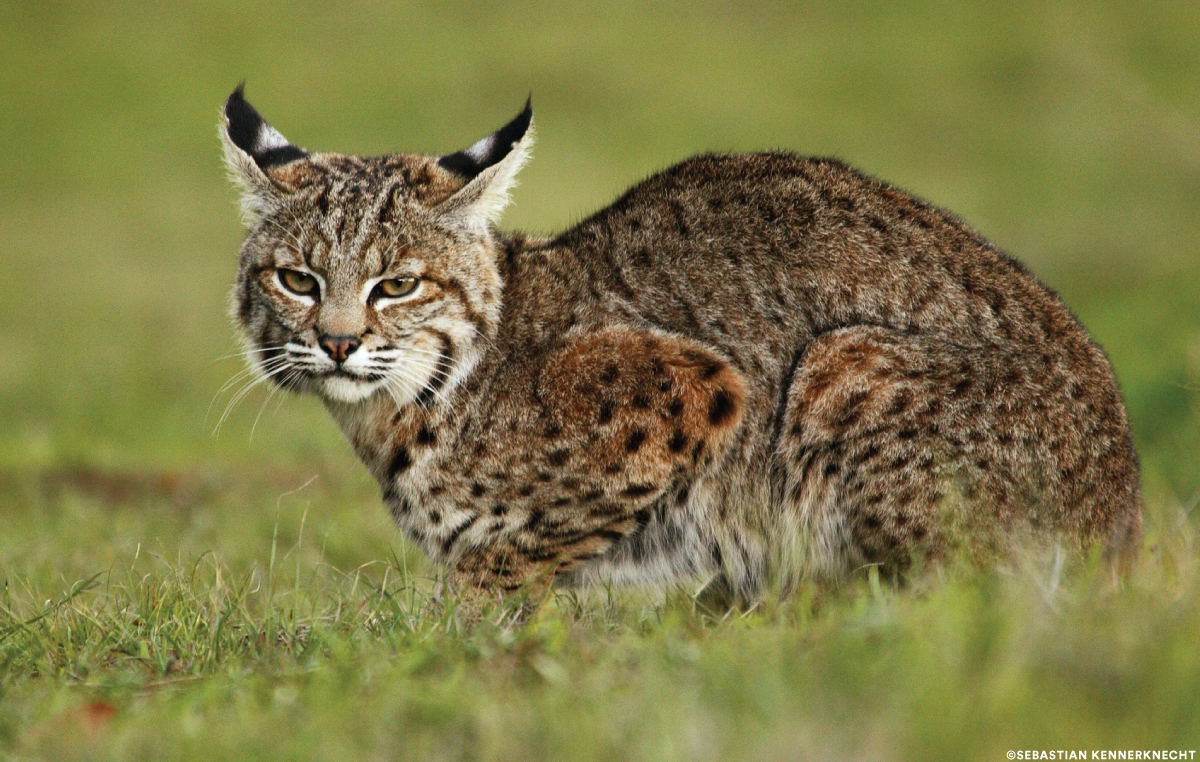
2. Bobcats
The bobcat (Lynx rufus), also known as the red lynx, is a medium-sized cat native to North America. It ranges from southern Canada through most of the contiguous United States to Oaxaca in Mexico. It is listed as Least Concern on the IUCN Red List since 2002, due to its wide distribution and large population. Although it has been hunted extensively both for sport and fur, populations have proven stable, though declining in some areas.[1]
It has distinctive black bars on its forelegs and a black-tipped, stubby (or “bobbed”) tail, from which it derives its name. It reaches a total length (including the tail) of up to 125 cm (50 in). It is an adaptable predator inhabiting wooded areas, semidesert, urban edge, forest edge, and swampland environments. It remains in some of its original range, but populations are vulnerable to extirpation by coyotes and domestic animals. Though the bobcat prefers rabbits and hares, it hunts insects, chickens, geese and other birds, small rodents, and deer.
| Domain: | Eukaryota |
| Kingdom: | Animalia |
| Phylum: | Chordata |
| Class: | Mammalia |
| Order: | Carnivora |
| Suborder: | Feliformia |
| Family: | Felidae |
| Subfamily: | Felinae |
| Genus: | Lynx |
| Species: |
L. rufus
|
| Binomial name | |
|---|---|
| Lynx rufus | |
https://en.wikipedia.org/wiki/Bobcat#

3. Siamese Cats

The Siamese cat (Thai: แมวไทย, Maeo Thai; แมวสยาม, Maeo Sayam) is one of the first distinctly recognized breeds of Asian cat. Derived from the Wichianmat landrace, one of several varieties of cat native to Thailand (formerly known as Siam), the original Siamese became one of the most popular breeds in Europe and North America in the 19th century
4. Bengals:
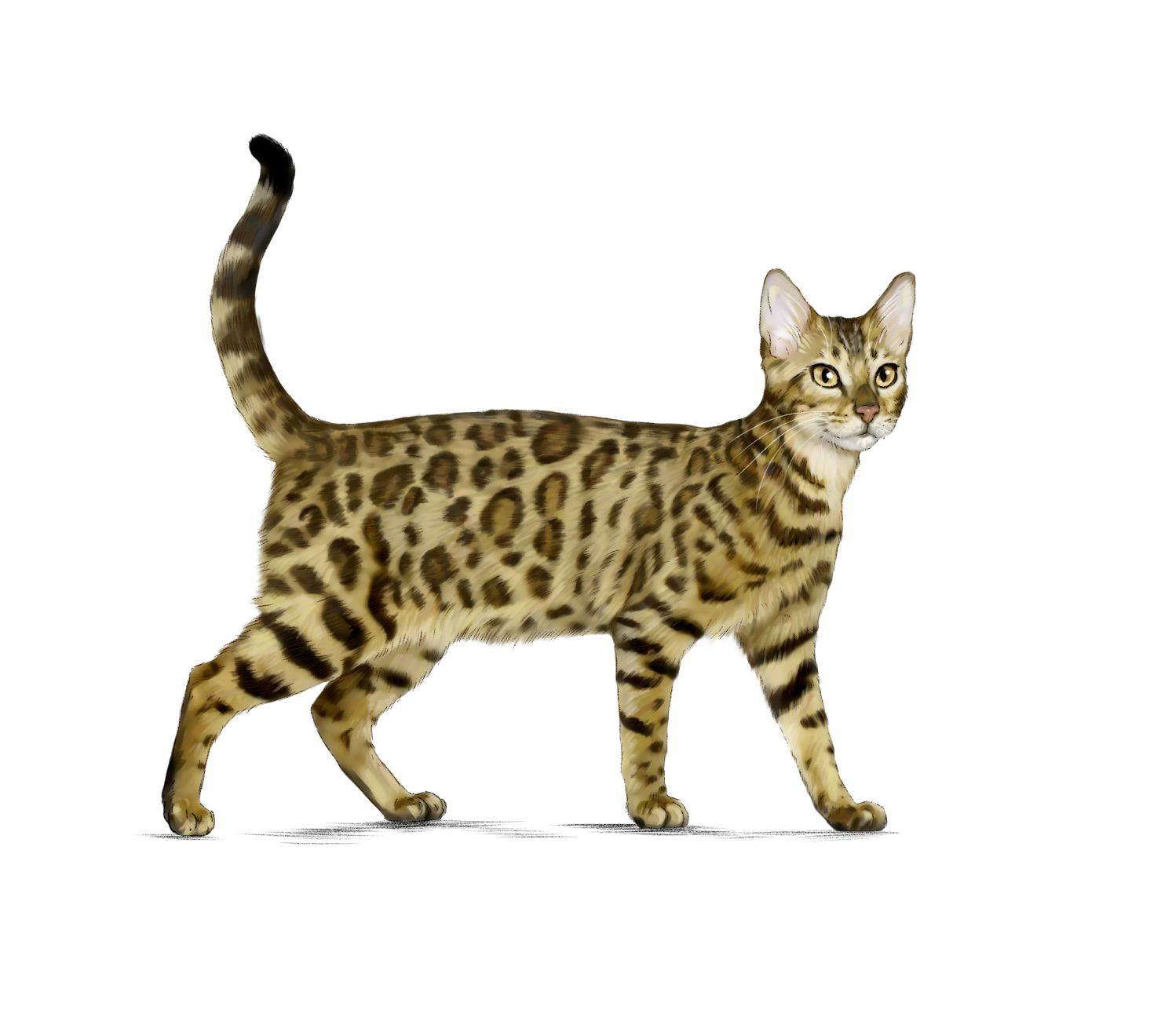
The Bengal cat is a domesticated cat breed created from a hybrid of the Asian leopard cat (Prionailurus bengalensis), with domestic cats, especially the spotted Egyptian Mau. It is then usually bred with a breed that demonstrates a friendlier personality, because after breeding a domesticated cat with a wildcat, its friendly personality may not manifest in the kitten. The breed’s name derives from the leopard cat’s taxonomic name.
Bengals have a wild appearance; their golden shimmer comes from their leopard cat ancestry, and their coats may show spots, rosettes, arrowhead markings, or marbling. They are an energetic breed that needs much exercise and play.

5. Sphynx
The Sphynx cat (pronounced SFINGKS, /ˈsfɪŋks/) also known as the Canadian Sphynx, is a breed of cat known for its lack of fur. Hairlessness in cats is a naturally occurring genetic mutation, and the Sphynx was developed through selective breeding of these animals, starting in the 1960s.[1]
According to breed standards, the skin should have the texture of chamois leather, as it has fine hairs, or the cat may be completely hairless. Whiskers may be present, either whole or broken, or may be totally absent. The cats have a narrow, long head and webbed feet. Their skin is the color that their fur would be, and all the usual cat markings (solid, point, van, tabby, tortie, etc.) may be found on the Sphynx cat’s skin. Because they have no fur, Sphynx cats lose body heat more readily than coated cats, making them both warm to the touch and prone to seeking out warm places. https://en.wikipedia.org/wiki/Sphynx_cat
6. Scottish Fold
The Scottish Fold is a breed of domestic cat with a natural dominant gene mutation that affects cartilage throughout the body, causing the ears to “fold”, bending forward and down towards the front of the head, which gives the cat what is often described as an “owl-like” appearance.[1]
Originally called lop-eared or lops after the lop-eared rabbit, Scottish Fold became the breed’s name in 1966.[1] Depending on registries, longhaired Scottish Folds are varyingly known as Highland Fold, Scottish Fold Longhair, Longhair Fold and Coupari.
All Fold cats are affected by osteochondrodysplasia (OCD) a developmental abnormality that affects cartilage and bone development throughout the body. This condition causes the ear fold in the breed and studies point to all Fold cats being affected by it. Fold cats therefore have malformed bone structures and can develop severe painful degenerative joint diseases at an early age. https://en.wikipedia.org/wiki/Scottish_Fold
The Wordsmith Collection: Writing & Creative Arts
Contact us through Square via square@writingresource.org
to donate to our funds at Missoula Federal Credit Union.
(editor@writingresource.org or timflanagan@writingresource.org)
 Please support Alternative Media and Education
http://www.RevolutionResource.org
http://www.ThePeaceresource.com
http://www.ThePortlandAlliance.org
and other real news resources…
Together we make a difference.
Thanks for all you do.
Join the Revolution!

