
NRHP Reference Number: 69000184
https://www.indian-affairs.org/medicinewheel.html
Finally, in June 2011, the efforts of the Association and the Medicine Wheel Coalition achieved the permanent protection of the Medicine Wheel and Medicine Mountain when the entire mountain was designated as a National Historic Landmark for its traditional cultural significance.
https://youtu.be/QJiVAZpmTPU
TheBighorn Medicine Wheel is a major Indigenous sacred site and archaeological landmark located in north-central Wyoming. It is one of the largest and most well-preserved stone medicine wheels on the Northern Plains.
Features and location
- Location: The wheel sits at nearly 10,000 feet in elevation on Medicine Mountain, within the Bighorn National Forest. It is located 12 miles south of the Montana border, with the nearest town being Lovell, WY.
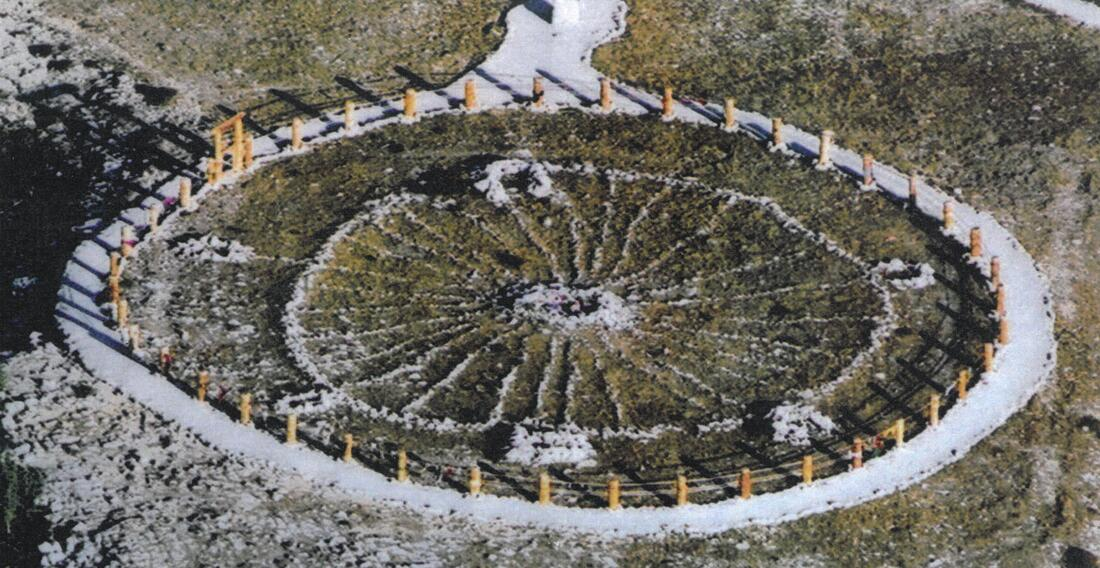
- Structure: This circular pattern of stones is about 82 feet in diameter. It has a central stone cairn from which 28 stone spokes radiate outward toward a peripheral circle.
- Age and history: The wheel is believed to be hundreds, and possibly over a thousand, years old. Archaeological evidence shows that the surrounding area has been used by Native Americans for at least 7,000 years. The Medicine Wheel was designated a National Historic Landmark in 1970, and its boundaries were expanded in 2011 to include the wider Medicine Mountain area.
Significance and use
- Spiritual and ceremonial use: The site is an active sacred place for many Indigenous peoples, including the Crow, Sioux and Northern Cheyenne tribes, who still hold ceremonies, vision quests, and medicinal plant gatherings there.
It is seen as an altar for the greater Medicine Mountain sacred complex. - Astronomical function: Astronomers have noted that the wheel’s design aligns with celestial events: the summer solstice and the rising of certain stars, suggest use as an ancient observatory or calendar. The 28 spokes may allude to the 28 days of the lunar cycle.
- Pilgrimage site: Many Indigenous peoples have historically made pilgrimages to the site, which in some traditions is viewed as a place to achieve a life’s purpose.
- Cultural resource protection: The site is collaboratively managed by the U.S. Forest Service with input from Native American tribes and other parties to protect its integrity as a sacred and nationally important cultural property.
Visiting the site
To get to the wheel takes a 1.5-mile hike from the lower parking area. Visitors may sometimes find a ceremony taking place; they should stand back and observe quietly.
Visitors are welcome but must be respectful, the wheel is an active place of worship.
Public access is typically available from mid-June or early July through mid-September, depending on snow conditions.

THE SACRED CIRCLE
The white man called the Medicine Wheel, but to many Native American Indians it is “The Place Where the Eagle Lands.” To many people, it is a sacred place, and there are few that leave without experiencing something outside the ordinary.
https://decolonialatlas.wordpress.com/wp-content/uploads/2023/10/turtle-island-decolonized-map-with-index.pdf
It is perhaps the location of the Medicine Wheel that contributes so powerfully to a feeling of sacredness and agedness. Lying atop Medicine Mountain, the weather here is as wild as the towering crags and sheer cliffs that define the mountain. Sleet, rain, and snowstorms are common here, even in July. Streaks of jagged lightning, deafening thunder, and wind scream past the rocky embattlements. These are the forces that confronted the people who came here, ages ago, to build a place of ceremony and worship.
Some people believe that the Medicine Wheel is a vision quest site, a representation of the Sun Dance Lodge, a turtle effigy, or a place to mark the summer solstice.
https://www.instagram.com/reel/C_GmvrmSJjk/?hl=en
The link above is an Indigenous-led Canadian non-profit digital application, an interactive map to help you visualize Indigenous territories, languages and treaties

https://www.fs.usda.gov/r02/bighorn/natural-resources/arch-cultural/medicine-wheel-medicine-mountain-national-historic
Bighorn Medicine Wheel was created by Sioux, Cheyenne, Crow, and other indigenous tribes who had previously inhabited Turtle Island for more than 30 thousand years.
https://youtu.be/kmyuyyejivM
The Bighorn Medicine Wheel
https://www.wyohistory.org/encyclopedia/medicine-wheel
“The Medicine Wheel/Medicine Mountain National Historic Landmark is located at an elevation of 9,642 feet near the crest of the Bighorn Mountains of north central Wyoming. It occupies a rolling limestone plateau 30 miles east of Lovell, Wyo., and 12 miles south of the Montana border. It is an important prehistoric archeological landscape as well as an ancient Native American spiritual site where tribal ceremonial activity continues to this day.”
…Researchers have identified as many as 150 medicine wheels in Montana, South Dakota, Wyoming and the Canadian provinces of Alberta and Saskatchewan. The Bighorn Medicine Wheel is unique among features of this type. It is the best-known, and one of the largest and best preserved on the northern and northwestern Plains. It was the first medicine wheel to be mentioned in popular literature and the first to be studied by the professional scientific community.
…

Resources
Sources
- Brumley, John H. “Medicine Wheels of the Northern Plains: A Summary and Appraisal.” Manuscript Series 12. Archaeological Survey of Alberta, Edmonton, 1988.
- Campbell, Gregory, James P. Boggs, and Fred Chapman. “Medicine Wheel/Medicine Mountain National Historic Landmark Nomination,” Wyoming State Historic Preservation Office, 2011. Accessed February 2019 at http://wyoshpo.state.wy.us/index.php/programs/national-register/wyoming-listings/view-full-list/411-medicine-wheel-medicine-mountain-national-historic-landmark.
- Chapman, Fred. “The Bighorn Medicine Wheel: Landscape Wars and Negotiating Native American Spirituality in the New West.” In Preserving Western History, edited by Andrew Gulliford. Albuquerque: University of New Mexico Press, 2005.
- Connor, Stuart W. “Archaeology of the Crow Indian Vision Quest,” Archaeology in Montana 23(3), 1982: 85-127.
- Eddy, John A. “Probing the Mystery of Medicine Wheels,” National Geographic Magazine 151(7), 1977: 140-146.
- Grey, D. “Big Horn Medicine Wheel Site, 48BH202,” Plains Anthropologist 8(19), 1963: 27-40.
- Grinnell, George Bird. “The Medicine Wheel,” American Anthropologist 24(3), 1922: 299-310.
- Liebmann, Matthew. “Demystifying the Big Horn Medicine Wheel: A Contextual Analysis of Symbolism, Meaning, and Function,” Plains Anthropologist 47(180), 2002: 46-56.
- Simms, S. C. “A Wheel-Shaped Stone Monument in Wyoming,” American Anthropologist, 5(1), 1903: 107-110.
Illustrations
The photo of the Medicine Wheel today is by Robert Clayton of rocdoctravel.com; the site contains more great photos of the Medicine Wheel and the landscape and geology around it—and around the West. Used with permission and thanks.
A useful but flawed reference:
https://solar-center.stanford.edu/AO/bighorn.html#
The Bighorn National Forest aerial photo of the Medicine Wheel is from the final National Historic Landmark nomination for the Medicine Wheel, completed in 2011. Used with thanks.
The photo of the Shoshone village near South Pass, 1870, is by William Henry Jackson. Used with thanks.
The 1934 photo of the landscape around the Medicine Wheel was taken by Seymour Bernfeld. It and the photo of archeological work underway at the Medicine Wheel by the Sheridan Chapter of the Wyoming Archeological Society are from the American Heritage Center at the University of Wyoming. Used with permission and thanks.
S.C. Simms’ closeup of the cairn is from the Field Museum of Natural History. Used with thanks.
The black-and-white photo of the Medicine Wheel showing the rock wall was taken in the 1920s by T.J. Dunnewald, a soils scientist from the University of Wyoming. Author’s collection, used with thanks.
The ground-level color photo looking east toward Medicine Mountain is by Richard Collier of the Wyoming State Historic Preservation Office. Used with permission and thanks.
“On top of the Bighorn Range in Wyoming, a desolate 9,642 feet high and only reachable during the warm summer months, lies an ancient Native American construction — an 80′ diameter wheel-like pattern made of stones. At the center of the circle is a doughnut-shaped pile of stones, a cairn, connected to the rim by 28 spoke-like lines of stones. Six more stone cairns are arranged around the circle, most large enough to hold a sitting human. The central cairn is about 12 feet in diameter and 2′ high.”
…Age estimates for the Medicine Wheel range from a few hundred years to more than 3,000 years.
Oral histories provided by Native Americans indicate the Medicine Wheel is indeed very old, extending back in time through many generations. The only reliable scientific date gleaned from the Bighorn Medicine Wheel thus far is one dendrochronologic sample derived from wood incorporated into the structure of the western cairn. This sample’s latest growth ring dates to 1760 CE. Past research suggests that the Medicine Wheel is a composite structure with the central cairn and some outer cairns constructed earlier than the rim and spokes. Artifacts and other archaeological evidence clearly indicate that the Medicine Wheel / Medicine Mountain NHL has been visited by Native Americans for nearly 7,000 years.
The NHL is managed by the Bighorn National Forest under a signed Historic Preservation Plan. Formal signatory consulting parties include the Medicine Wheel Alliance (Tribal), Medicine Wheel Coalition (Tribal), Big Horn County commissioners, Bighorn National Forest, Federal Aviation Administration, Wyoming State Historic Preservation Office, and the Secretary of Interior’s Advisory Council on Historic Preservation.

https://www.facebook.com/groups/482092393472602


