

Indigenous American History is difficult to unravel…

Shown here is Moving Robe Woman, a Hunkpapa Sioux

(Sitting Bull’s branch of the Sioux). INSP explains:
Moving Robe Woman was no stranger to battle. At age 17, she took part in a war party alleged to have involved the Crow tribe. But often these intertribal wars were exaggerated or invented.
In July 1876, now at about age 23, she was among the Sioux and Lakota who camped at the Greasy Grass (Little Big Horn). On this fateful day, she was digging turnips when a warrior rode by… warning women to take their children to the hills. General Custer was about to attack.
Moving Robe Woman raced back to her lodge where she learned that her brother, One Hawk, had been killed in an earlier battle with Custer’s men.
Now, in deep mourning and perhaps fueled by revenge, Moving Robe braided her hair, painted her face red, mounted her horse, and with her brother’s war staff in hand, galloped into battle. “I was a woman,” she reportedly said, “But I was not afraid.” (There seems to be some contradictions in this account. Why did she have her brother’s war staff?)
Her determination emboldened the male warriors to fight ferociously for their way of life, in what would end up an overwhelming victory for Native Americans. Custer’s entire cavalry, 268 men, himself included, were killed—at least one at the hands of Moving Robe. She may have gotten her vengeance, but it was bitter, and came at a cost. She later said, “[No one] staged a victory dance that night. They were mourning their own dead.”
Moving Robe Woman died in 1935 at Standing Rock Reservation in South Dakota. She was about 81 years old.
Moving Robe Woman – Hunkpapa heroine
Moving Robe Woman (1854-1935) was a Hunkpapa Lakota woman who fought during the Battle of the Little Bighorn in 1876 to avenge her brother.
Moving Robe Woman https://en.wikipedia.org/wiki/Moving_Robe_Woman#
Moving Robe Woman (Sioux name Tȟašína Máni), also known as Mary Crawler, Her Eagle Robe, She Walks With Her Shawl, Walking Blanket Woman, Moves Robe Woman, Walks With Her Robe and Tashenamani [1][2][3] was a Hunkpapa Sioux woman who fought against General George Custer during the Battle of Little Big Horn to avenge her brother, One Hawk, who had been killed.[4][5]
Early life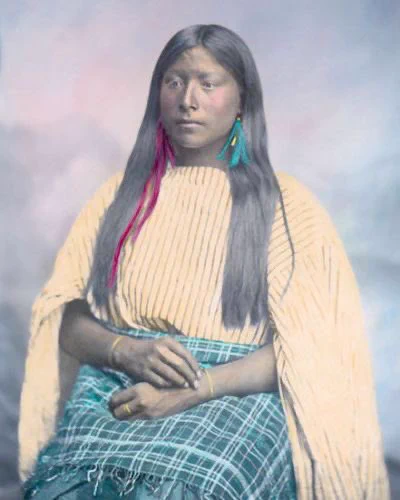
Moving Robe Woman was born near the area now called Grand River, South Dakota.[5] Her father’s name was Crawler; he was also known as Siohan[6] and was the Hunkpapa band chief,[4] also present at the battle. Her mother was Sunflower Face.
At the age of 17, Moving Robe Woman traveled to Montana with a war party to battle against the Crows.[3] When she was about 22 years old, she and her family moved to Peji Sla Wakapa, known in English as the Little Big Horn.[5]
Battle of Little Big Horn
When she was 23, she heard news from her parents that her brother was killed by Pehin Hanska (the Lakota name for Custer) and his soldiers. Shortly thereafter, a troop of soldiers charged on horseback into the large Lakota village near the Greasy Grass River and began firing their guns.[5] Later in the battle an Oglala Lakota warrior named Fast Eagle claimed that he had held Custer’s arms while Moving Robe Woman stabbed him in the back.[7] However, several other warriors claimed to have killed Custer, and it is uncertain that Moving Robe Woman actually killed him. There are no published post-mortem accounts that describe Custer as having stab wounds, and officers who found his body described him as having died of gunshot wounds.[citation needed]
She also avenged her brother’s death by killing two of Custer’s men, one with a knife and the other with a revolver. The latter was the army interpreter Isaiah Dorman.[8]
Later years
After the ending of the battle at the Little Big Horn, she moved with her people to Canada, where she remained until 1881. She then moved to the Kenel area of Standing Rock. The Standing Rock Family Information Survey notes that in 1923 at age 70, Moving Robe Woman was living alone in a one room log house with a connected barn on the Grand River west of Bullhead, South Dakota. The survey also noted that she owned 18 horses and 23 cattle.[3]
Interview
An interview with Moving Robe Woman, made at Fort Yates, North Dakota by Frank B. Zahn,[3][4] is published in Richard G. Hardorff’s book, Lakota Recollections of the Custer Fight, New Sources of Indian-military History.[5] In the interview she describes her emotions upon hearing of her brother’s death at Little Big Horn:
“My Heart was bad. Revenge! Revenge! For my brother’s death. I thought of the death of my young brother, One Hawk. I ran to a nearby thicket and got my black horse. I painted my face with crimson and braided my black hair. I was mourning. I was a woman, but I was not afraid.”[3]
Visual representations
She was photographed in 1937 (personal details above indicate that she died in 1935) at age 83 by F.B. Fiske; the photograph by Fiske is held in the National Anthropological Archives of the Smithsonian Institution.[9]
The American artist Thom Ross has created a 200-piece installation of the battle, including a painting of Moving Robe Woman.[10]
See also
References
- ^ “Little Big Horn Warriors (LBH Warriors)” (PDF). Friends of Little Big Horn. Retrieved 1 October 2020.
- ^ Shilling, Vincent. “Fight the Power: Heroes of Native Resistance, Women Warriors”. Indian Country Today. Retrieved 1 October 2020.
- ^ Jump up to:a b c d e Waggoner, Josephine (2012). Witness: A Hunkpapha Historian’s Strong-Heart Song of the Lakotas. Lincoln: University of Nebraska Press. p. 665. ISBN 9780803245648. Retrieved 20 October 2020.
- ^ Jump up to:a b c Hardorff, Richard G. (2004). Indian Views of the Custer Fight: A Source Book. University of Oklahoma Press. pp. 185–186. ISBN 0806136901.
- ^ Jump up to:a b c d e Hardorff, Richard G. (1991). Lakota Recollections of the Custer Fight: New Sources of Indian-Military History. University of Nebraska Press. pp. 91–96. ISBN 0803272936.
- ^ “LBH (Little Big Horn) Warriors” (PDF). Friends of Little Big Horn. Retrieved 20 October 2020.
- ^ Miller, David Humphreys (1957). Custer’s Fall: The Indian Side of the Story. New York: Bison Books (E.P. Dutton reprint). p. 210. ISBN 0-8032-8129-3.
- ^ Hardorff (2004) p.90,
- ^ “Dakota Woman, Mary Crawler”. National Anthropological Archives, Smithsonian Institution. Retrieved 20 October 2020.
- ^ Ross, Thom (Summer 2005). “Custer’s Last Stand, An Artist’s Perspective”. Montana: The Magazine of Western History. 55 (2): 48–53. JSTOR 4520693. Retrieved 20 October 2020.
Further reading
- “Little Big Horn Associates, names beginning with M”, URL accessed 07/03/06
- “Dakota Datebook June 24, 2005, ‘Moving Robe Warrior Woman'” from Prairie Public Television at Prairiepublic.org URL accessed 05/25/06
- “Little Big Horn Associates, names beginning with C”, URL accessed 07/03/06
- Tasinamaniwin, United States, Native American, Census Rolls, 1885-1940. (Death certificate, Mary Crawler). Familysearch.org. URL accessed 10/9/2018
|
||
|

Please donate to keep us online with writing & creative arts.
 Please Donate to help keep these Resources!
Contact us through Square via square@writingresource.org
to donate to our funds at Missoula Federal Credit Union.
Can also donate here:
http://www.ThePortlandAlliance.org/donate
Thanks for supporting Alternative Media and Education
Contact Tim with questions
(editor@theportlandalliance.org )
Please support Alternative Media and Education
http://www.RevolutionResource.org
http://www.ThePeaceresource.com
http://www.ThePortlandAlliance.org
and other real news resources…
Together we make a difference.
Thanks for all you do.
Join the Revolution!
Please Donate for Literacy and to keep this resource.

